Synthetic Personas: How I Turned 11 Interviews into AI Agents
AI-augmented research method: 11 in-depth interviews become agents that represent the personas and validate features, journeys and screens without reaching out to users again.
- Client
- PP Concursos
- Year
- 2026
- Categories
- AI Solution

AI in Product Design Beyond the Prompt
The most common use of AI in product design today is the prompt. You ask for a screen, a piece of copy, a component variation, adjust the result in conversation and move on. That handles isolated tasks competently and does not handle process: when the problem is recurring and depends on accumulated context, asking again does not scale.
What changes the level is structuring a harness around the model, that is, an explicit arrangement of context, memory, tools, output format and human checkpoints, which determines what the AI can consult, what it can execute and where the decision remains with the person designing. Better prompts improve today's answer. A harness improves tomorrow's answer, because every correction becomes a rule instead of becoming another attempt.
The research persona was the first artifact in my process where I applied that logic end to end, and it was on the PP Concursos project, starting from 11 in-depth interviews with Brazilian public legal exam candidates, that I developed, tested and validated the method. Instead of synthesizing a document about the user, I treated the persona as a system: raw data, structured memory, a query tool and a behavior contract that defines how it thinks and speaks. The result is a synthetic persona.
What a Synthetic Persona Is
A synthetic persona is an AI agent that represents a user profile defined from real research data. The distinction matters: it is not AI-generated text describing a hypothetical user, and it is not a chatbot simulating empathy with generic knowledge. Its personality comes from the collected material, from what people said, how they said it and what they showed they value. The role of AI is different: turning that material into a queryable system, with its own memory, able to answer questions nobody asked during the interview.
In practice, a synthetic persona relies on three components: a vector knowledge base holding the records of that profile, a system prompt that works as a personality contract and a tool layer that allows it to receive product artifacts and return a structured assessment. That combination is what makes the virtual user exist as a working instrument rather than a presentation piece.
The gain is operational before it is conceptual. The 11 interviews stop being an archive you consult through manual search and start operating as living memory during design: every flow decision, every interface label and every business rule can be confronted with what users already said, without depending on a new round of scheduling.
Data Treatment: The Stage That Defines the Result
Nothing that comes later holds up if the treatment is poor. The agent answers from the memory it received, so answer quality is a direct consequence of how the raw data was treated. If the transcript was summarized, the agent loses vocabulary. If it was fragmented beyond reason, it loses context. If it was turned into running text without metadata, it loses traceability. Treating research data is information engineering, not file organization, and that is where most of the project effort actually went.
Each interview produced 60 to 75 minutes of conversation, full of noise: greetings, digressions, verbal tics, connection drops and repeated questions. The temptation is to send everything to a language model and ask for a summary. That destroys exactly what the agent needs: the vocabulary, the tool names and the way the person speaks.
What you want is the opposite of a summary. You want memory. The treatment has five moves:
Deep cleaning. Remove fillers, repetitions and technical markers while preserving the substantive content of every answer.
Granular segmentation. Every pain, every described flow and every scenario becomes an independent block. Granularity defines the agent's precision: a monolithic block returns a blur, a small block returns a specific answer.
Rewrite in the first person. The block stops being a transcript and becomes a memory: complete, self-sufficient sentences written as if the person were speaking. Meaning is preserved, including when the interviewee contradicts themselves at different moments of the conversation.
Tagging. Each block receives markers such as
[PAIN POINT],[MENTAL MODEL],[EXTERNAL TOOLS]and[USER GOAL], which allows filtering the base by type and not only by theme.JSON structure. Each block becomes a record with an identifier, source excerpt, context, profile, confidence and version.
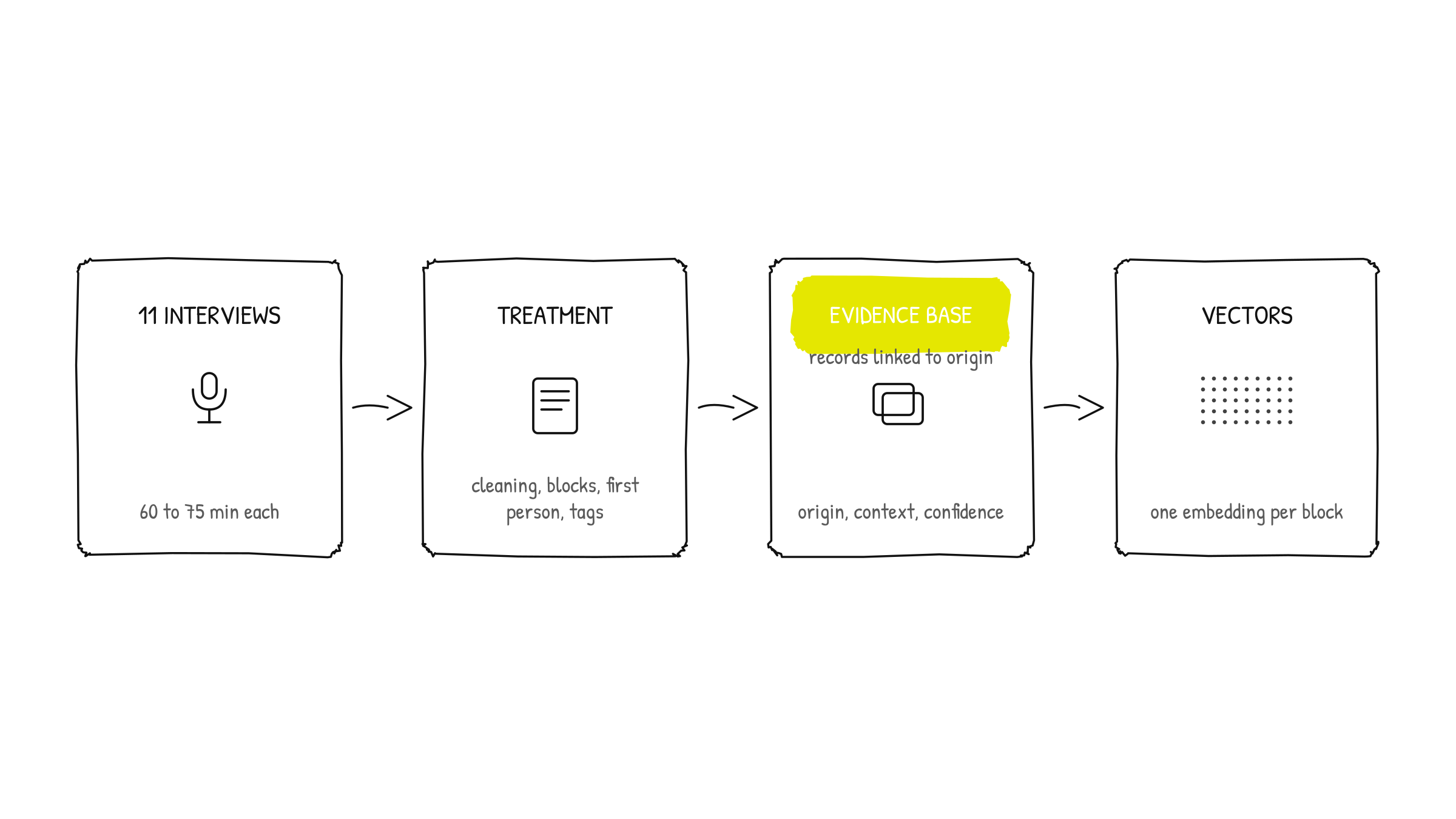
Two rules hold the quality of this layer. The first: tool names and technical terms are preserved exactly as they were said. When a student says "I drop the PDF into Gemini and build a closing summary", Gemini and closing summary belong to her vocabulary, and that vocabulary is what gives the agent authenticity later. The second rule: the original corpus is never changed. The treated record is a lens over the raw data, not a replacement for it. If anyone questions something the agent says, the path back to the transcript has to exist.
Treatment also does not end when the blocks are generated. A sample of the records is checked against the original transcript before the base is accepted, because systematic error is easier to detect in a small sample than in a large volume. The result is what I started calling an evidence base: records searchable by meaning, each one linked to its origin and ready to be vectorized.
Eleven People, Three Archetypes
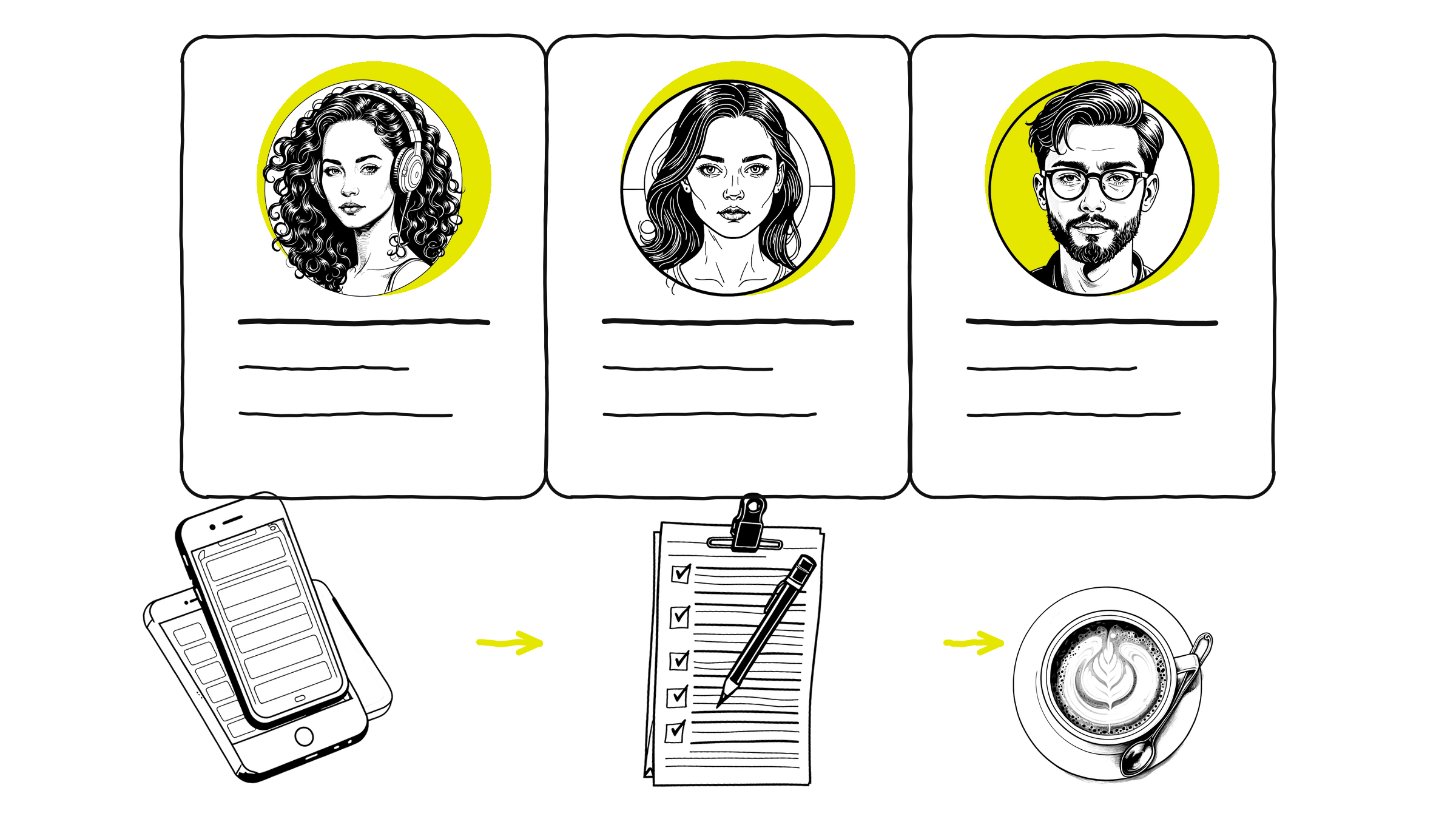
With the base ready, synthesis stops being intuition and becomes a reading of recurrence. Three archetypes emerged clearly from the 11 conversations.
Mariana, the organized candidate (32, lawyer, Belo Horizonte). She has been studying for prosecutor exams for two years, follows a rigid schedule, studies three to five hours a day and uses question banks on her own. Her problem is not discipline, it is operational cost: she spends too much energy managing spreadsheets and apps just to know whether she is progressing. In her words, "I have the best material with PP, but I spend an enormous amount of energy managing spreadsheets and apps to know if I am really progressing".
Rafael, the disorganized beginner (27, temporary civil servant, Recife). Six months into the journey, he alternates intense periods with weeks off, downloads ready-made schedules he rarely follows and sees approval as a symbol of a different life. "I start motivated, then I get lost in the middle of PDFs and messages. It feels like I study a lot and learn little."
Camila, the persistent tightrope walker (35, court technician, Curitiba). She is already a public servant, wants to move up without giving up the stability she has, and splits her time between work, children and night study. "I do not need anyone to tell me what to study, I need help seeing whether I am evolving, and motivation when I am not."
The criterion matters more than the result. A persona is not an average, it is recurrence: a pattern mentioned by one person is an isolated hypothesis, mentioned by five it is group behavior. And contradiction is not a defect to be cleaned. When the same interviewee sounds confident in one excerpt and insecure in another, that oscillation is exactly what the agent will have to reproduce to feel like a real person.
The Architecture of a Persona Agent
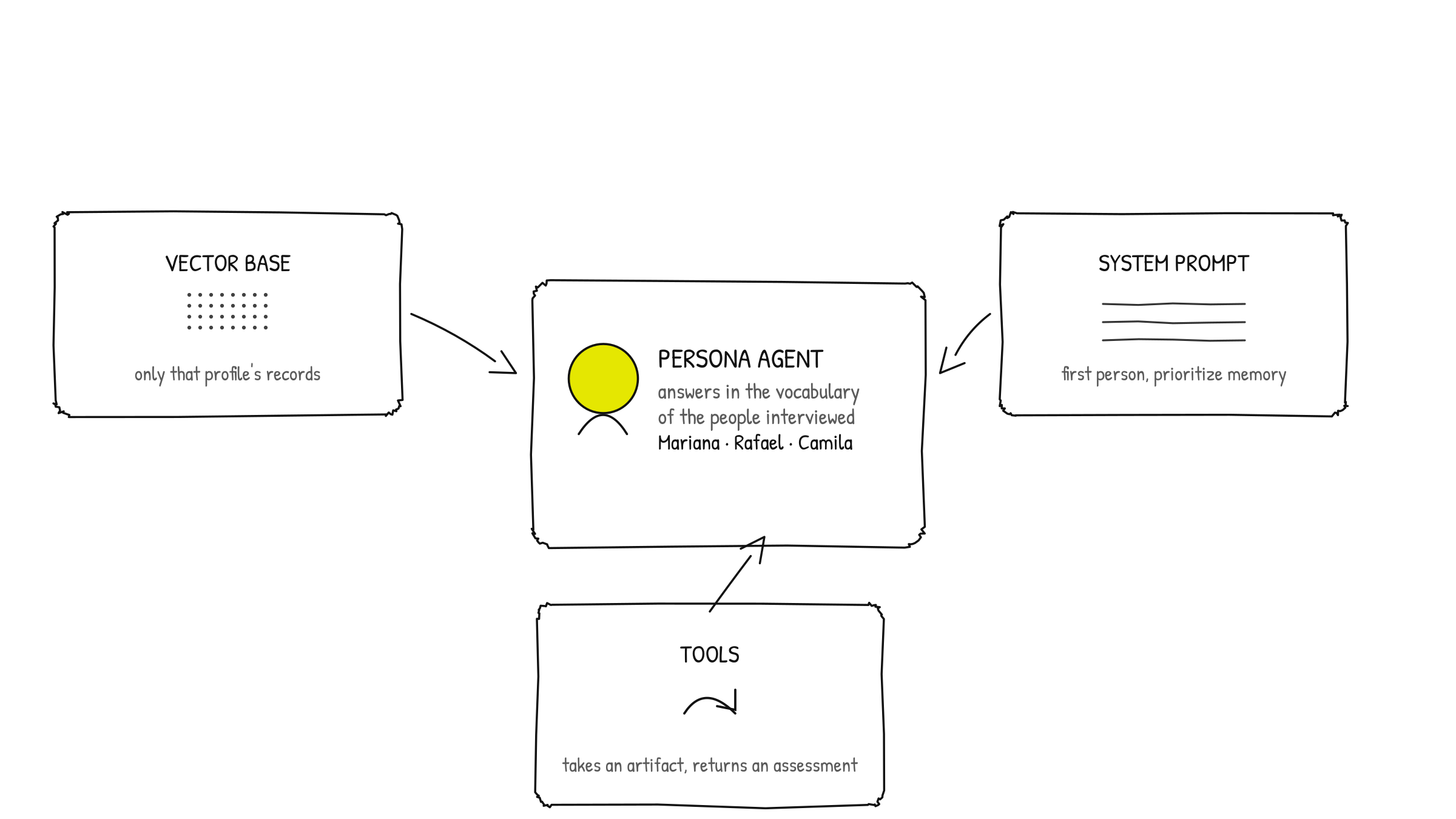
Each archetype became an agent with three components.
Its own vector knowledge base. Only the records of that archetype go into its collection. Storage sits in a relational database with vector capability, PostgreSQL with the pgvector extension, which allows combining filters by profile and metadata with similarity search. The designer's question is turned into a vector and the system retrieves the memory blocks closest in meaning, not in wording. That is what allows the agent to answer about difficulty keeping consistency when the question is about abandoning the schedule halfway through.
A system prompt as a behavior contract. This is the core of the design and where personality fidelity is decided. Four rules: always answer in the first person and in the original vocabulary; base the answer primarily on the retrieved memory excerpts; never mention that an interview, a transcript or a database exists behind it, answering as if that were its own opinion; and, when the memory does not cover the question, say that it does not know instead of filling the gap with generic knowledge.
Agentic tools. The agent is not a chat that only replies. It receives artifacts and runs the validation cycle: it reads the description of a journey, a screen or a business rule, queries its own memory, crosses what was proposed against what it has lived through and returns a structured assessment, in a format I defined, with points of acceptance, friction, doubts and rejection criteria. That tool layer is what turns the vector base into a testing instrument instead of a museum of quotes.
The Validation Cycle Without Reaching Out to Users
Day to day use is direct. Before taking a decision to users, I send the material to the three agents. What travels in that request:
Journeys and flows. The proposed step by step, from first access to task completion.
Screens and components. What exists on each screen, information hierarchy and interface labels.
Business rules and models. Recurring billing, level progression, usage limits, everything that usually generates real friction.
What comes back from each persona: where it would get stuck, what it would misread, which information it would look for and not find, and which part of the flow it would consider unnecessary. Each response arrives in a different vocabulary, and that difference is the value of the process. Mariana questions the cost of maintaining one more tool, Rafael needs explicit direction so he does not get lost on the first step, Camila will not accept a schedule that changes every week without explaining why.
With that, the iteration cycle stops depending on scheduling. Adjustments that used to wait for the next research round, or that were simply never tested to avoid bothering the client, now get checked on the same day, as many times as needed. And when a new research round does happen, it arrives with far more mature material in hand.
Limits and Verification
Three precautions come with the process and are worth recording, because a resource like this is easy to be fooled by.
Confidence bias. A well-written output looks true, and fluency is not proof of fidelity to the data. Verification is sample based: compare the agent's answer against the original transcript and check whether that opinion was actually expressed. Above a small error rate, the fix is in the system prompt or in the granularity of the blocks.
Skill erosion. Someone who has never treated an interview by hand has no repertoire to judge whether the agent is making things up. Automating extraction before doing it manually is the fastest way to produce volume that looks rigorous.
An archetype is not a person. Mariana condenses patterns from several interviews. She is useful for testing and prioritizing design hypotheses, never to be quoted as a real user nor to replace talking to actual people in high-stakes decisions.
A synthetic persona answers what is already in the data, using the vocabulary of someone who lived it. It does not discover what nobody said and takes no responsibility for any decision. Judgment stays human, and the role of the system is to shorten the path to the moment when that judgment is needed.
A well-built persona agent is not a shortcut to skip research. It is what allows every round of research with real users to start much closer to the right answer.