The End of Design for All: The Era of Adaptive UI and Our Role in It
Published on
How AI enables per-individual personalization and what this philosophically changes in the product designer profession.
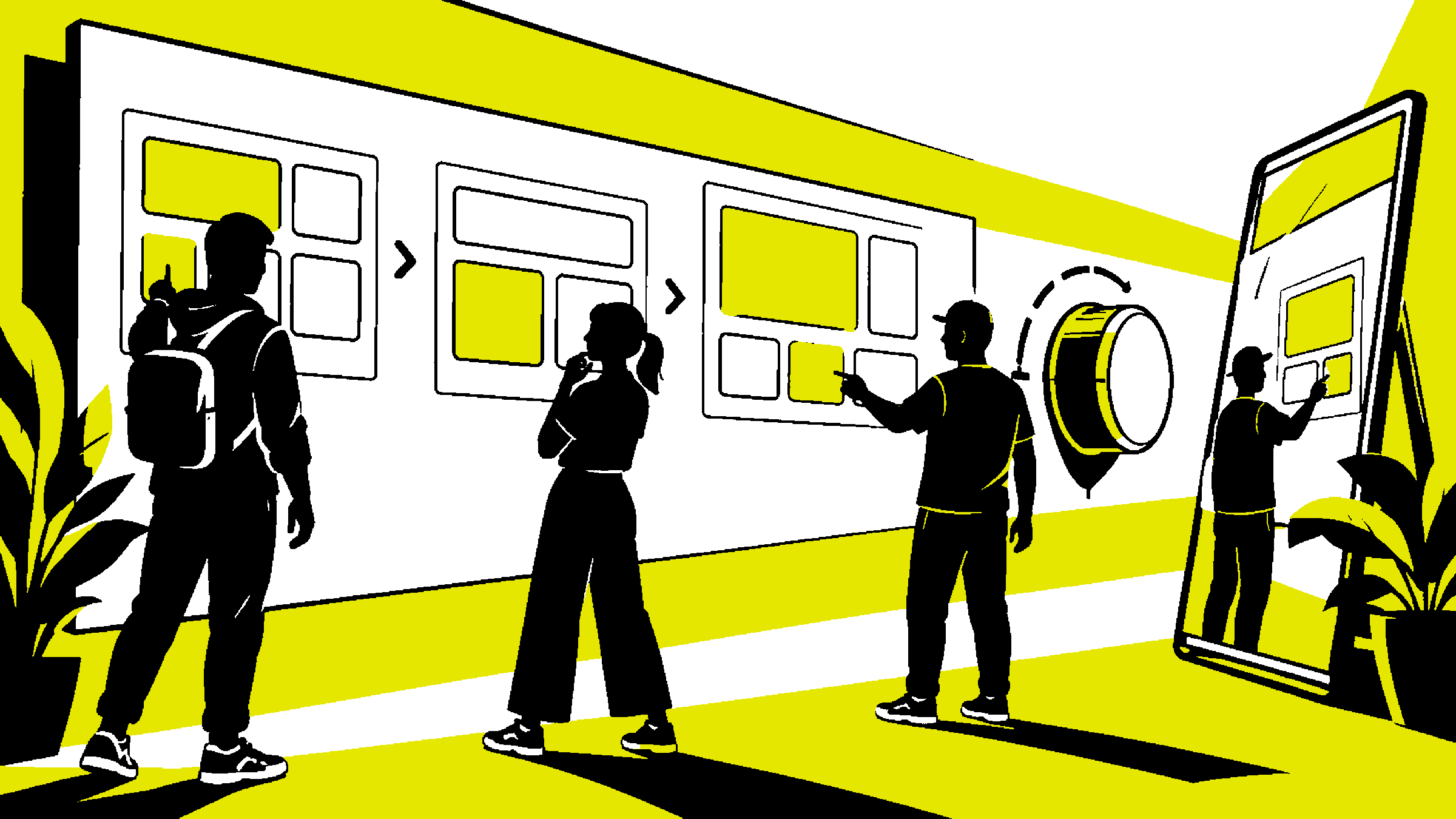
Not long ago, the conviction guiding much of what I designed was clear: create a singular interface that works for everyone. The mantra of "design for all" was almost unquestioned. Yet, as I revisit projects from a decade ago, and reflect on recent advances in AI and adaptive systems, I realize how that premise is no longer tenable—or even desirable. We have entered an era where interfaces no longer promise universality but instead embrace individuality at their core.
The End of One-Size-Fits-All: Why UI Must Adapt
I often return to the notion of operational mapping—how users move through a system, the choices they make, the points where friction arises. In traditional design, this mapping tries to find a "common path" that works pretty well for the broadest possible audience. The challenge, however, is that this common path is always a compromise. It smooths cognitive friction for some, but often at the expense of others whose contexts, habits, or cognitive styles don't align with the majority.
The video "The Future of Interfaces" beautifully illustrates how emerging technologies—particularly AI-driven systems—enable UIs that shift dynamically based on the individual's behavior, preferences, and needs. It's not a question of multiple preset profiles anymore but rather a continuous adaptation, sometimes imperceptible, sometimes intentional. This is a fundamental pivot away from static templates towards fluid, living interfaces.
Discovery of Understanding in Adaptive Systems
From my perspective, the design process must now lean heavily into what I call the discovery of understanding. Instead of assuming what users need based on aggregate data or persona archetypes alone, we lean on real-time triangulation of evidence: behavioral data, emotional cues, contextual signals. The interface itself becomes a collaborator in revealing the user's needs.
For instance, consider a news platform that adapts not only the articles shown but the very way information is structured: some users favor visual summaries, others dive into dense text, and a third group scans key points before deciding to read deeper. The system observes and subtly reshapes navigation paths and information hierarchies accordingly.
Philosophical Implications for the Designer's Role
What does this mean for us as designers who have long worked with fixed systems and standardized components? It signals a profound shift in the systems architecture we devise—not just at the technical level but at the conceptual level. The design no longer lives solely in static deliverables but in dynamic processes and ongoing feedback loops.
The Designer as a Curator of Experience, Not a Dictator of Form
One of the more unsettling tensions I observe is the loss of control. Traditional design prized coherence, predictability, and consistency—qualities that become slippery when every user interface can look and behave differently. We must embrace a new mindset where we curate a family of possible experiences rather than craft a single definitive one.
This curation role is intensely humanistic. It requires us to anticipate how adaptive mechanisms might shape user identity, agency, and trust. How do we ensure that the system's adaptations respect individual autonomy rather than manipulate or confine? What ethical boundaries do we draw around personalization?
Cognitive Friction: Friend or Foe in Adaptive UI?
Adaptive interfaces can drastically reduce cognitive friction by tailoring complexity and information flow. Yet, they can also introduce new forms of friction—uncertainty about why something appears or behaves differently, loss of predictability, or even alienation when adaptation misses its mark. As designers, we must map these frictions carefully, understanding their sources and consequences. This requires integrating qualitative insights with quantitative signals to keep the user's lived experience central.
Practical Steps Toward Adaptive Design Leadership
- Expand discovery phases beyond static research. Incorporate continuous observation and feedback loops that capture evolving user states.
- Design modular systems with built-in flexibility. Rather than crafting fixed layouts, create building blocks that can rearrange intelligently.
- Develop ethical frameworks for personalization. Define clear guardrails around data usage, consent, and transparency.
- Collaborate closely with AI and data experts. Build shared mental models around predictive algorithms and their limitations.
- Document adaptive patterns as living guidelines. Update them regularly as the system learns and shifts.
Humanity at the Core of Adaptation
Ultimately, this evolution challenges us to reconsider the very meaning of "user-centered design." If the UI itself changes with the user, the boundaries between designer, system, and user begin to blur. Our responsibility is to ensure that this convergence amplifies human dignity, curiosity, and freedom rather than diluting them.
Adaptive design is not simply a new toolset or trend. It is a philosophical reorientation. By embracing its nuances, we can help craft digital environments that resonate deeply with the diversity and complexity of human experience—and in doing so, honor the very purpose of our craft.